Flat Rack vs Open Top Container: Key Differences

Flat rack containers have no side walls or roof, making them ideal for oversized, over-width, or extremely heavy cargo. Open-top containers have enclosed side walls with a removable tarpaulin roof, making them the right choice for tall cargo that fits within standard width. The deciding factor is usually cargo width vs height.

If you have cargo that can’t be shipped inside a standard container, your best options are either a flat rack container or an open-top container.
Both are specialized shipping containers designed to ship cargo that doesn’t fit the standard box format. Among different container types, these two are commonly used for oversized cargo or irregular shipments. But shippers often get confused as to which of these two is the right option for them. Choosing the wrong type adds cost, complicates handling, and can create compliance issues in international shipping.
In this article, we’ll look at the difference between a flat rack vs open top container, including their steel structure, design, and the cargo they can handle. By the end, you’ll get a complete understanding of which one is right for you.
Key takeaways: Flat rack vs open top container
- Flat rack containers are best for over-width, heavy, or irregular cargo, with open sides and no roof for maximum loading flexibility.
- Open top containers are ideal for over-height cargo within standard width, offering enclosed side walls and a removable roof for top loading.
- The core difference comes down to protection vs flexibility: open tops protect cargo better, while flat racks allow more loading access and fewer size constraints.
- Selecting the right container type upfront prevents costly equipment swaps at the depot, avoids unexpected out-of-gauge surcharges, and reduces your total freight spend.
What Is a Flat Rack Container?
A flat rack container is a specialized shipping container with a strong, reinforced base and two fixed or collapsible end walls, but no roof or sidewalls. They are designed for heavy, awkward “out-of-gauge”, or oversized cargo such as machinery, pipes, or vehicles that cannot fit inside standard shipping containers. They are available in 20ft, 40ft flat rack, and 45ft flat rack sizes.
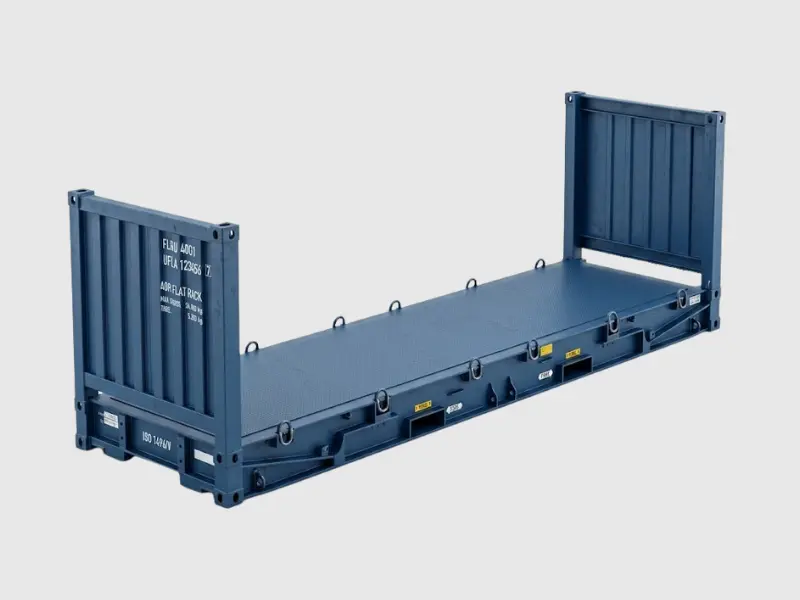
For cargo safety, flat rack containers have multiple lashing rings. Hence, the cargo stays securely fastened on the flat rack throughout the transit.
Here are some of the key features of a flat rack container:
- Steel platform base: Offers a strong base for heavy cargo and has integrated forklift pockets and lashing rings.
- End walls: Collapsible or fixed end walls at each short end of the container (these are the only walls the container has).
- No side walls: The design allows for shipping awkward or oversized cargo that can’t fit inside standard container walls.
- No fixed roof: Allows for tall cargo to be shipped.
- Lashing rings: These are added along the platform perimeter for securing irregular or heavy cargo.
- High load capacity: Flat racks have one of the highest loading capacities among container types, so you can easily load heavy industrial equipment and oversized shipments.
Learn more about flat rack containers here.
What Is an Open Top Container?
An open-top container is also a specialized shipping container that doesn’t have a solid steel roof. Instead, it offers a removable tarpaulin or hard-top lid, designed for loading over-height or bulky cargo from the top via crane. They are available in 20ft open top and 40ft open top sizes and are used for transporting oversized machinery, steel, and industrial materials.
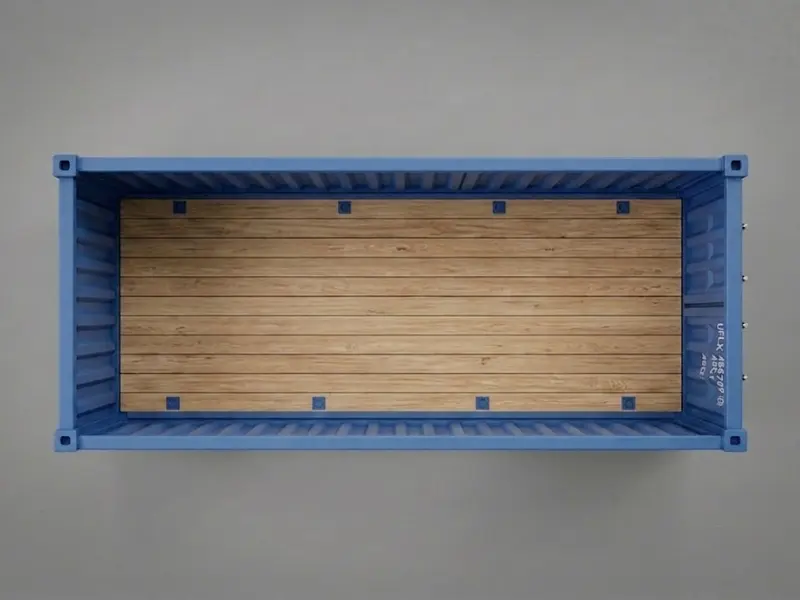
Key features of open-top containers:
- Fully enclosed side walls: The container has solid side walls, end walls, and a door set so your cargo is protected on all four sides.
- Removable tarpaulin roof: Instead of a solid steel roof, it comes with a removable tarpaulin roof that provides weather protection while allowing top loading.
- Consistent container width: The internal container dimensions of open top containers match those of standard containers, so you can estimate the loading capacity and storage space easily.
- Lashing rings: Features lashing rings on the floor and walls for securing cargo inside.
- Overhang allowance: It’s ideal for tall cargo that can’t fit inside a standard container. You can just remove the tarpaulin cover to accommodate it.
Read more about open-top containers here.
Flat Rack vs Open Top Container
| Feature | Flat Rack | Open Top |
| Side walls | None | Fully enclosed walls |
| Roof | None | No solid roof, removable tarpaulin |
| End walls | Fixed or collapsible bulkheads at each end | Fixed (with doors) |
| Loading method | Side, top, end & vertical loading | Top (crane) or end |
| Height restriction | No height limit | Primarily for cargo taller than a standard container |
| Width restriction | Can accommodate “over-width” cargo | Standard container width, since it has fixed side walls |
| Weight restrictions | Highest (reinforced base for concentrated loads) | High (similar to standard heavy-duty containers |
| Cargo protection | Minimal (tarpaulin strapped over cargo) | Offers more protection as it has solid side walls, and the tarp covers the top |
| Use cases / best for | Oversized width/length heavy cargo | Tall cargo that requires top loading |
| Collapsible option | Yes (collapsible end walls) | No |
| Standard sizes | 20ft, 40ft, 45ft | 20ft, 40ft |
What are the Key Differences Between Flat Rack and Open Top Containers?
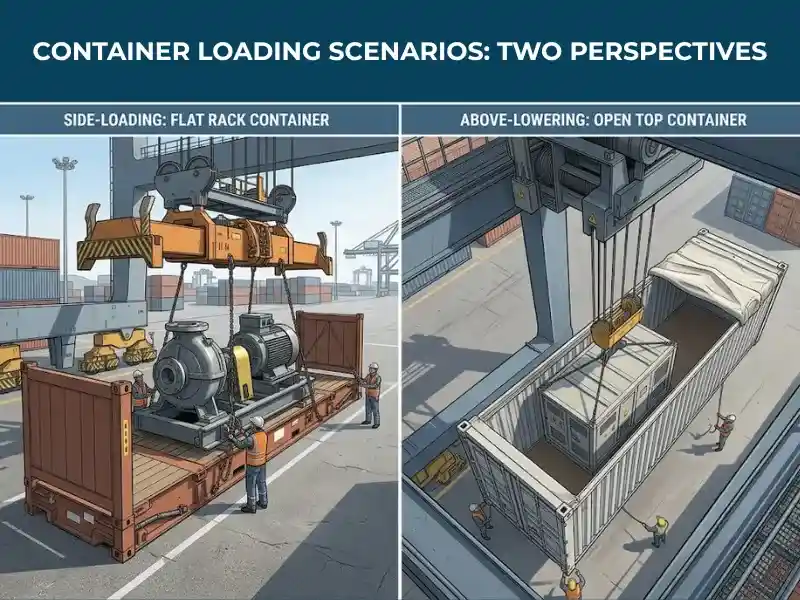
Flat rack containers are open on the sides and top, making them ideal for oversized or heavy cargo that needs flexible loading from multiple directions. Open top containers, on the other hand, have solid side walls and use a removable tarpaulin roof, offering better protection while still allowing cargo to be loaded from above.
Structure & Design
In any standard container, the side walls, floor, and roof work together to create a rigid, solid box that protects your cargo and the container itself from elements. This is how most container types are structurally designed for durability and transport safety.
In special containers like open-top or flat-rack, this is not available. So here’s how the two maintain their structural integrity:
- Open top: As we mentioned, this is essentially a standard container with a missing roof. Because the roof (which usually provides a lot of stability) is gone, the side walls are reinforced to prevent them from bowing outward. For efficient loading, the rear header, which is the bar above the doors, is designed to swing out or be removed entirely. This allows a crane to drop cargo in without hitting the top of the door frame.
- Flat rack: Since there are no side walls or roof, the entire structural load is carried by the base. Because of this, the floor of a flat rack is significantly thicker and more heavily reinforced with steel beams than an open top. The end walls are incredibly strong and prevent the cargo from sliding forward or backward during transit.
In short, an open top relies on its reinforced side walls for strength, while a flat rack relies on the heavy-duty base frame.
Loading Methods
In a flat rack container, cargo can be loaded from anywhere (top, side, or end). While in an open-top, it has to be loaded from above.
Open top loading methods:
- Top-loading (crane): This is the most common method. Since there is no roof, a crane can lower heavy or awkward items (like large glass sheets or heavy scrap) directly into the container from above.
- End loading through doors: Just like standard containers, you can load the cargo through the container door if it fits, and this method doesn’t require crane equipment.
Flat rack loading methods:
- Top loading: The cargo is lifted by crane and set down onto the platform surface. This is common for loading large pipes or boilers.
- Side loading: The cargo is slid or rolled onto the flat rack from either long side using forklifts, heavy equipment, or specialized rollers.
- End loading: Cargo can also be loaded from either short end when the end walls are in the collapsible position. This option isn’t available for fixed-end flat-rack containers.
Cargo Types
Here are some of the specific cargo types that are shipped in these containers.
For open-top containers:
- Any tall cargo that exceeds standard container height limits but fits within standard container width.
- Glass panels and similar fragile materials that need to be placed carefully in the container and need enclosed side protection.
- Heavy machinery like wind turbine blades and similar elongated components.
- Bulk minerals or scrap metal items like coal, ores, or heavy copper scrap can be loaded simply by dumping them in from an overhead hopper.
- Construction materials that need to be craned in from above.
- Irregular cargo like tree saplings, where top access is required, but side protection is equally important.
For the following cargo, flat rack containers make more sense:
- Construction equipment such as bulldozers, excavators, and large tractors. These are often wider than a standard container and far too heavy for a regular wooden floor.
- Yachts and oversized boats, because a boat’s hull is usually much wider than a container. Or jet engines or fuselage sections, as they require specific lashing points.
- Project cargo, industrial turbines or transformers that can weigh 40+ tons. Such heavy materials require the reinforced ‘I-beams’ found in a flat rack’s floor to prevent the container from snapping in half.
- Over-width industrial boilers or massive concrete piping sections that must be loaded from the side because they are too long and wide to maneuver through rear doors.
Here’s a golden rule we advise container buyers when they’re selecting between the two.
If you can’t fit it through the “front door” because of height, go open top.
If you can’t fit it because of width or extreme weight, go flat rack.
But let’s understand where it makes sense to use a flat rack vs. an open-top container in more detail.
When to Use a Flat Rack Container
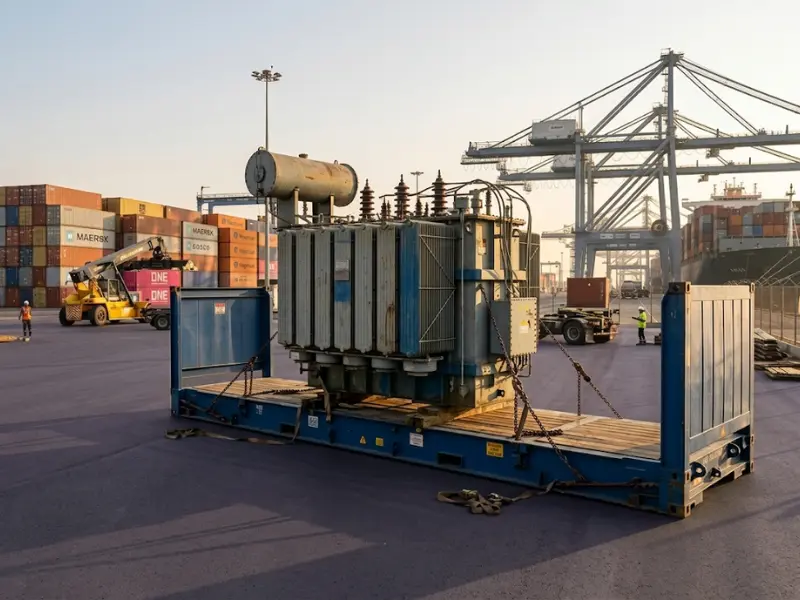
Use flat-rack containers when your cargo is too wide, too heavy, or too structurally irregular to fit in any container with walls.
It’s also useful if you’re shipping extremely heavy industrial machinery, as the platform is built specifically for heavy loads.
Specific scenarios where flat rack containers are the correct container type:
- Oversized cargo: If your cargo is wider than 2.35 meters (approx. 7 ft 8 in), it physically can’t fit inside an open top or a standard container.
- Extremely heavy machinery: If the cargo weighs more than 30,000kg (for a 40ft unit), opt for a flat rack unit as its reinforced platform can easily handle the load.
- Complex cargo loading requirements: Cargo that needs to be rigged, crane-lifted, and set down with precise positioning requires unrestricted side access that a flat rack provides.
- Large vehicles and rolling stock: To transport cargo that is too large or heavy for roll-on/roll-off loading and too wide for enclosed containers, flat rack containers are a natural fit.
It also makes economic sense to use a flat rack container if you’re only using it for one-way transport. The collapsible ends mean you can easily stack 4-5 units of flat racks, which is about the same space as a standard container on a vessel. So you save a significant amount on your return shipping costs.
When to Use an Open-Top Container?
Open top containers are the right choice when cargo is too tall for a standard container but still fits within the standard container width.
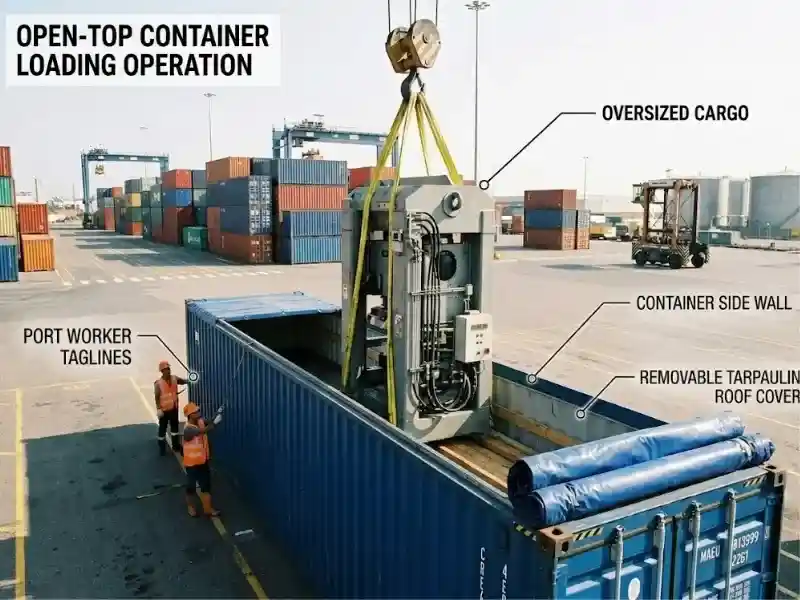
Here are some specific use cases where it’s the right choice:
- Tall cargo within standard width: Any machinery, equipment, or materials taller than 2.38m (standard container interior height) but no wider than standard container dimensions are ideal open top candidates.
- For fragile materials: Open tops are the right choice for materials like glass panels that need top loading but also need enclosed walls for protection.
- For difficult rear loading: Sometimes cargo isn’t over-height, but it’s so heavy that a forklift can’t lift it high enough to clear the top bar of a standard container door. As we mentioned, most open tops have a removable rear header so you can swing it out of the way, slide your cargo in, and then lock the header back into place.
- Bulk materials loaded from above: Materials like scrap metal, glass sheets, or large bags of minerals that need to be loaded by conveyor or crane bucket into the container.
To help you better understand which is the right choice for you, let’s take a look at the container dimensions and capacity that each of these containers can hold.
Container Dimensions & Capacity Comparison Between Open Top and Flat Rack Containers
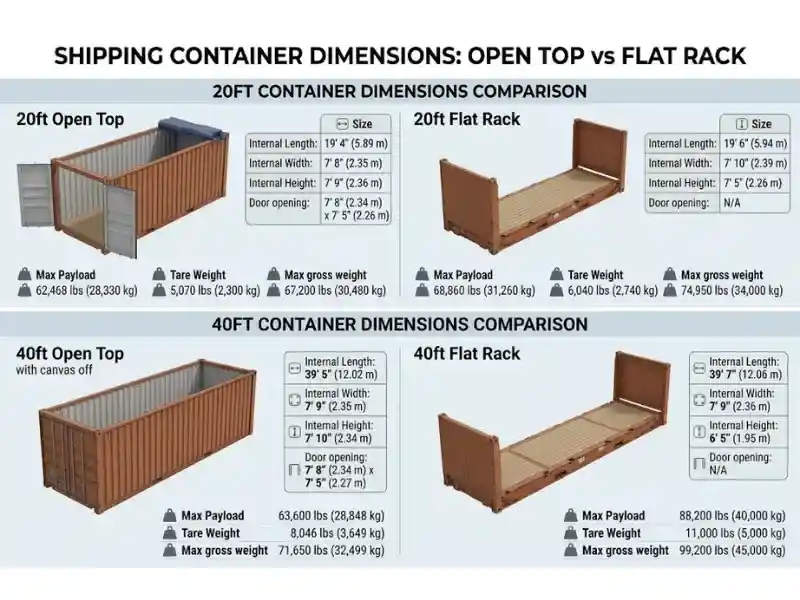
For both flat racks and open tops, the most common sizes are the 20ft and 40ft versions. Here’s a comparison between the two to help you make the right choice.
| 20FT container dimensions comparison | ||
| Specification | 20ft Open Top | 20ft Flat Rack |
| Internal Length | 19′ 4″ (5.89 m) | 19′ 6″ (5.94 m) |
| Internal Width | 7′ 8″ (2.35 m) | 7′ 10″ (2.39 m) |
| Internal Height | 7′ 9″ (2.36 m) | 7′ 5″ (2.26 m) |
| Max Payload | 62,468 lbs (28,330 kg) | 68,860 lbs (31,260 kg) |
| Tare Weight | 5,070 lbs (2,300 kg) | 6,040 lbs (2,740 kg) |
| Max gross weight | 67,200 lbs (30,480 kg) | 74,950 lbs (34,000 kg) |
| Door opening | 7′ 8″ (2.34 m) x 7′ 5″ (2.26 m) | N/A |
| 40FT container dimensions comparison | ||
| Specification | 40ft Open Top | 40ft Flat Rack |
| Internal Length | 39′ 5″ (12.02 m) | 39′ 7″ (12.06 m) |
| Internal Width | 7′ 9″ (2.35 m) | 7′ 9″ (2.36 m) |
| Internal Height | 7′ 10″ (2.34 m) | 6′ 5″ (1.95 m) |
| Max Payload | 63,600 lbs (28,848 kg) | 88,200 lbs (40,000 kg) |
| Tare Weight | 8,046 lbs (3,649 kg) | 11,000 lbs (5,000 kg) |
| Max gross weight | 71,650 lbs (32,499 kg) | 99,200 lbs (45,000 kg) |
| Door opening | 7′ 8″ (2.34 m) x 7′ 5″ (2.27 m) | N/A |
Pros and Cons of Open Top and Flat Rack Containers
When choosing between these two, it usually comes down to a trade-off between protection (open top) and flexibility (flat rack).
Here is the breakdown of the advantages and drawbacks for each:
Open Top Container |
|
| Pros | Cons |
| All-weather protection: The tarpaulin and side walls keep cargo dry and protected from the elements. | Width restrictions: You are strictly limited by the permanent steel side walls. |
| Lateral security: Rigid walls prevent cargo from shifting outward during rough seas. | Tarp maintenance: Tarpaulins can tear or leak if not maintained or lashed correctly. |
| Easier customs clearance: Since it looks like a standard box, it’s often easier to inspect and seal. | Limited loading angles: You can only load from the top or through the rear doors. |
| The removable rear bar allows for easy entry of tall items via forklift. | If cargo is very tall, the lack of a steel roof reduces some structural rigidity. |
| Lower freight costs: Generally cheaper than flat racks as they take up standard vessel slots. | Height surcharges: If cargo sticks out the top, “out-of-gauge” fees still apply. |
Now let’s take a look at the pros and cons of flat racks.
Flat Rack Container |
|
| Pros | Cons |
| Infinite width/height: Ideal for over-dimensional cargo that physically cannot fit in any container. | Exposure to elements: Cargo is completely exposed to wind, rain, and salt unless manually wrapped. |
| Multi-directional loading: Can be loaded from the sides, the top, or the ends. | Complex securing: Requires extensive lashing, bracing, and welding to keep cargo safe. |
| Reinforced floor: Can handle heavy weight in a small area. | Higher freight rates: Usually the most expensive shipping option. |
| Return shipping: Empty units can be folded and stacked to save on return shipping costs. | Specialist handling: Requires specialist handling and lashing expertise. |
| Heavy-duty lashing: Comes with many more heavy-duty rings and points for securing heavy chains. | Strict balancing: Cargo must be perfectly centered to avoid structural failure of the base. |
Pricing Differences Between Flat Racks and Open Top Containers
Both flat racks and open top containers have a higher purchase price and freight rates than standard containers. This is due to their limited supply in the container market, the fact that they require special slots on a vessel, and require special handling equipment.
Here’s a realistic estimate of the costs.
| Cost Component | Open Top (OT) | Flat Rack (FR) |
| Base Freight Rate | Moderate (1.5x – 2x standard) | High (2x – 3x standard) |
| OOG Surcharge | Applicable if the cargo exceeds the top. | Applicable if cargo exceeds the top or sides. |
| Lost Slot Fees | Charged for height protrusion. | Charged for height and width protrusion. |
| Handling Fees (THC) | 25%–50% higher than standard. | 0%–100% higher (special gear needed). |
| Lashing/Securing | Lower (walls provide support). | High (requires chains, timber, welding). |
| Tarp/Covering | Included (standard tarpaulin). | Extra (often requires bespoke crating/wrapping). |
Here’s a detailed explanation of why the prices of these special containers are higher than standard ones.
- The “lost slot” premium: If your cargo sticks out of an open top, the vessel loses one slot above it, so you have to pay for that. Similarly, on a flat rack, if your cargo occupies space above, to the left, and to the right, you have to pay for that space too.
- Specialized handling & equipment: Most ports and depots have automated cranes that can lift standard containers. But handling specialized cargo requires manual crane operations, specialized spreaders, or heavy-lift gear at the port, all of which trigger significantly higher terminal handling charges (THC).
- Lashing and Labor: Open tops use the side walls for stability, keeping lashing costs lower. Flat racks require professional-grade securing, like heavy-duty chains, timber bracing, and even welding steel stoppers to the base, which adds a hefty bill for specialized labor and materials.
These are just a few of the factors that affect the pricing. Always get in touch with your logistics partner to get a detailed overview of what it would cost to ship materials in these special shipping containers.
How to Choose the Right Shipping Container?
Here’s a list of practical questions that will help you choose the right container.
- Does cargo exceed standard container width (2.35m)?
Flat rack is the only viable container option. - Does cargo exceed standard container height (2.38m) but fit within standard width?
An open-top container is likely the right choice. - Does the cargo require side protection during transit?
The open top provides enclosed walls, while the flat rack does not. - Is the cargo extremely heavy (above 28 tonnes)?
Flat rack handles higher weight limits. - Does the cargo need to be loaded from the side?
Only flat rack containers allow side loading. - Is the cargo fragile or sensitive to weather exposure?
Open top’s enclosed walls and tarpaulin provide better protection than a flat rack tarpaulin. - Will empty shipping containers need to be returned cost-effectively?
Flat rack with collapsible end walls reduces return freight cost. - Is the cargo irregular in shape?
Flat rack provides better access for complex handling.
If you need more guidance, get in touch with our team. Our experts will guide you towards the right choice based on your specific requirements and will also provide you with the best buying or renting options.
Vatsala Singh is a B2B content strategist and writer specializing in the shipping, logistics, and container industry. She has written extensively about container types, container modifications, procurement challenges, and the market shifts that influence container demand.
With a Master’s degree in English Literature and strong research skills, she brings depth, clarity, and accuracy to every article. Through her content, she combines industry knowledge with practical insight, helping readers understand what’s happening in global trade and how it affects container buyers, freight forwarders, and equipment managers.
When she’s not writing, Vatsala is usually reading fiction, exploring new ideas, or learning about how different industries work.
She believes that good content should simplify complexity, support smarter decisions, and make the container world easier to navigate, one article at a time.
Flat Rack vs Open Top Container: Frequently Asked Questions
What is the difference between a flat rack and an open top container?
A flat rack has no side walls or roof, making it suited for oversized cargo that needs loading from multiple directions. An open-top container has enclosed side walls with a removable tarpaulin roof, providing more cargo protection while still allowing crane loading from above.
How do shipping lines handle cargo that sticks out above an open top container?
Cargo that extends above the side wall height of an open top container is classified as an out-of-gauge shipment. Shipping lines charge an overhang surcharge and require prior approval, and the tarpaulin is removed or modified to accommodate the height.
Are flat rack containers suitable for storing equipment on a construction site?
Flat racks are designed for transport rather than on-site storage because they provide no weather protection for stored equipment. A standard dry container or high cube container is a far more practical option for construction site storage needs.
Can open-top containers be used for bulk grain or aggregate shipping?
Yes, open-top containers are a great option for bulk materials that are loaded from above, including grain, scrap metal, sand, and aggregate. The enclosed side walls contain the material during transit, and the open roof allows loading by conveyor or crane bucket.
What is the price of a 40ft flat rack container?
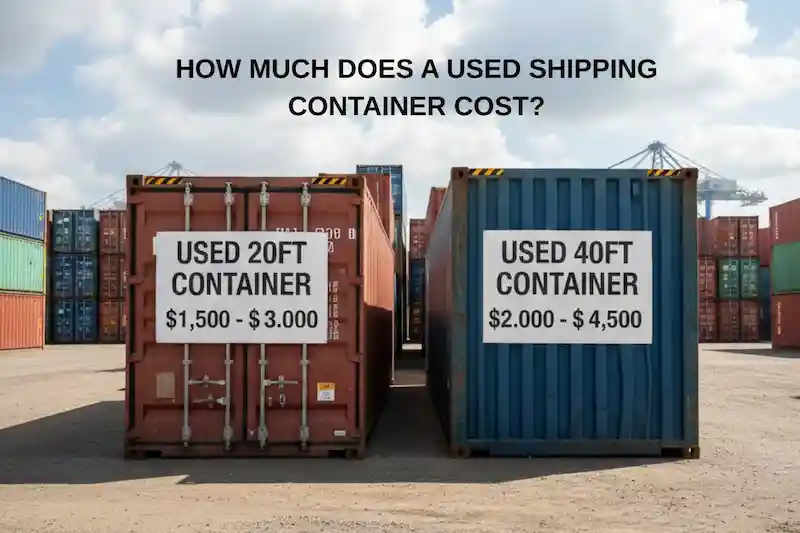
A new (one-trip) 40ft flat rack container typically costs between $5,500 and $8,500, while used cargo-worthy units range from $3,000 to $5,500. Prices vary based on location, global logistics and the demand and supply in the market.
What is the price of a 40ft open top container?
A new (one-trip) 40ft open top container typically costs between $4,500 and $9,000, while used units range from $2,800 to $5,000. The exact price depends on your location, the availability of containers in your area and global shipping conditions.